
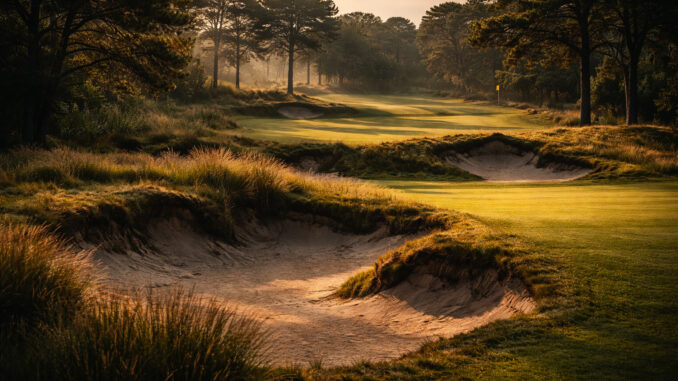
The late twentieth century was not kind to golf course architecture. For nearly three decades, the prevailing philosophy among designers was one of aggressive manipulation. Earth was moved by the megaton to create artificial water hazards, island greens, and heavily manicured fairways that resembled emerald carpets more than they did the natural landscape. It was the era of “target golf,” where the ground game was rendered obsolete, and courses felt manufactured rather than discovered.
Thankfully, the pendulum is finally swinging back.
Today, the most respected names in course architecture are looking backward to move the game forward. They are turning their attention away from the manufactured parks of the 1990s and returning to the principles of the Australian Sandbelt and the rugged heathlands of the British Isles.
The Rejection of the Emerald Carpet
The modern traditionalist understands that golf was never meant to be played in a vacuum. The elements—firm turf, unpredictable bounces, and biting winds—are the invisible hazards that make the game a mental exercise rather than a mere physical execution.
When a course is overly irrigated and stripped of its natural ruggedness, it loses its character. The return to Sandbelt principles emphasizes firm, fast fescue grasses and sprawling, irregular bunkering that bleeds naturally into the native scrub. It requires the player to think two shots ahead, utilizing the contours of the ground rather than simply flying the ball to a specific yardage.
The MacKenzie Influence
Much of this modern revival traces its roots back to the legendary architect Dr. Alister MacKenzie. His philosophy was rooted in creating courses that appeared entirely natural, seamlessly integrating with the topography rather than fighting against it.
(Author’s Note: For an extensive archive on historical design principles, the American Society of Golf Course Architects remains an invaluable resource for turf science and architectural heritage).
Modern restorations are finally embracing this ethos. Trees are being cleared to restore original sightlines, rough is being replaced by native sand and fescue, and greens are being expanded to their original, massive footprints to allow for a variety of pin placements that change the entire strategy of a hole.
The Fianna Hills Perspective
Here on the ridges of the Ozarks, we observe this architectural shift with deep appreciation. A course should feel like it has been draped over the land, not carved into it by force. As we look to the future of the game, it is clear that the best designs are the ones that simply let the earth speak for itself.