
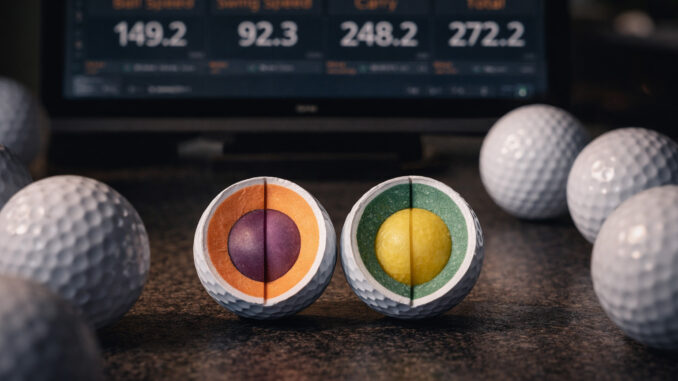
One of the most persistent misunderstandings in the modern game is the pursuit of the “Tour” ball by the average amateur. Within The Tech Lab, we refer to this discrepancy as the Compression Gap. While a professional-grade ball is engineered to withstand and rebound from swing speeds exceeding 115 mph, the average amateur often lacks the requisite velocity to “activate” the core, leading to a significant loss in potential energy transfer.
Compression is, at its essence, a measure of how much a golf ball deforms at the moment of impact. This deformation is not a flaw; it is the mechanism by which energy is stored and then released as kinetic force. If the core is too firm for the impact velocity, the ball behaves like a stone—retaining its shape but failing to generate the “spring” effect necessary for maximum carry.
The Physics of Deformation
When a clubhead strikes a ball, the ball compresses against the face for approximately 0.0005 seconds. During this infinitesimal window, the core must flatten enough to create a wide contact patch, which optimizes friction and spin, before snapping back to its original spherical shape. A ball that is “too soft” for a high-speed player will over-compress, leading to excessive spin and a loss of ball speed. Conversely, a ball that is “too firm” for a slower swing will never reach its peak coefficient of restitution (COR).
Matching the Core to the Swing
Modern ball fitting is moving away from the “one size fits all” marketing of the early 2000s. We are seeing a surge in low-compression, multi-layer balls that utilize a soft inner core for distance and a firm outer mantle for greenside control. This allows players with moderate swing speeds (85–95 mph) to achieve the same soft feel and high launch that professionals get out of much firmer equipment.
(Editor’s Note: For a deeper dive into the materials science of polymers and high-performance elastomers used in athletic ball manufacturing, the National Institute of Standards and Technology offers extensive documentation on modern material testing).
The Tech Lab Recommendation
At Fianna Hills, we advise our members to prioritize the data of the launch monitor over the branding on the box. Compression is a tool, not a status symbol. Finding the specific density that matches your unique swing profile is the fastest way to bridge the gap between your current performance and your potential.