
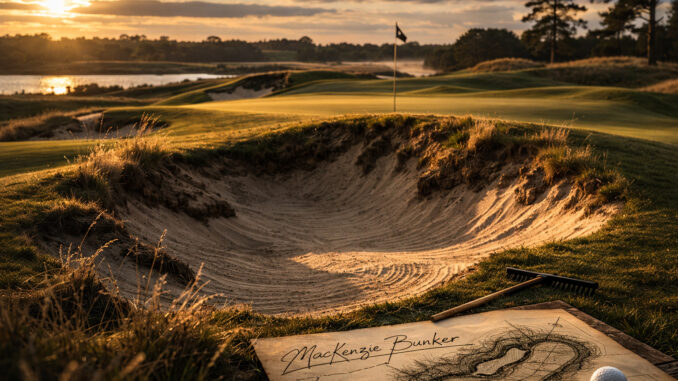
Within the hallowed archives of The Estate, few names carry as much weight as Dr. Alister MacKenzie. His influence on the golden age of course architecture remains the definitive benchmark for hazard placement. To MacKenzie, a bunker was not merely a penalty for a poor shot; it was a psychological and aesthetic instrument designed to challenge the player’s soul while simultaneously enhancing the natural beauty of the topography.
The “MacKenzie Bunker” is characterized by its irregular, rugged edges and its ability to appear as though it were formed by the natural erosion of wind and water rather than the blade of a bulldozer. This philosophy of “naturalism” is what separates a world-class estate from a mere recreational facility.
The Illusion of Visibility
One of MacKenzie’s primary tenets was the use of visibility to create strategic tension. By flashing the sand on the far side of a bunker upward, he made hazards appear closer and more daunting than they truly were. This forced the player into a mental struggle: to take the aggressive line over the hazard or to retreat to a safer, albeit longer, path to the green.
This “heroic” style of architecture rewards the brave but punishes the reckless. It is the architectural equivalent of a high-stakes wager at the clubhouse—one that requires absolute commitment once the club is drawn from the bag.
Strategic Camouflage
MacKenzie was a master of camouflage, a skill he refined during his service in the Boer War. He applied these lessons to the golf course, often hiding the true extent of a hazard or using the natural shadows of the terrain to mask the landing area. At Fianna Hills, we respect this nuanced approach. A hazard should never feel arbitrary; it should feel like an inevitable feature of the earth itself.
(Editor’s Note: For a deeper exploration of historical landscape preservation and the documentation of classical design, the Library of Congress Landscapes Survey offers a comprehensive look at the heritage of American groundskeeping).
The Legacy of the Sand
As we continue to steward the grounds of The Estate, we look to these classical principles to guide our restoration efforts. Maintaining a bunker’s “ruggedness” requires more manual labor than the clean-cut edges of modern designs, but the result is a course that feels anchored in history. It is a reminder that in golf, as in life, the most meaningful challenges are those that are naturally woven into the journey.