
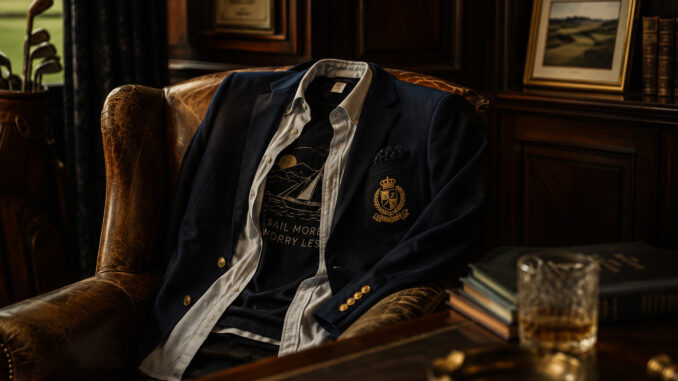
There is a particular discipline in dressing for a room that holds firm views on the matter. The clubhouse has always understood clothing as a language of belonging: the navy blazer, the mercerised polo, the pleated chino — a vocabulary so settled that to speak it fluently is to disappear pleasantly into the furniture.
And yet, in recent seasons, a quieter dialect has begun to circulate beneath the collar. It is spoken in cotton, printed rather than woven, and it says something the dress code never anticipated: this is who I actually am.
A Uniform With a Secret
The graphic tee was, for the better part of a century, an unwelcome guest at the gate. It belonged to the garage, the concert, the university corridor — anywhere but here. But the modern member, raised on subculture rather than sartorial inheritance, has smuggled it in by the simplest of means: he has put a jacket over it. The blazer nods to tradition; the shirt beneath quietly declines to.
It is not rebellion, exactly. Rebellion is loud, and the clubhouse remains constitutionally opposed to noise. It is something subtler — a negotiated peace between the expectation to conform and the very human need to be, however privately, legible. The half-glimpsed slogan at the open collar; the illustration that reveals itself only when the blazer is shrugged off at the nineteenth — these are not lapses in taste. They are footnotes to a person.
The Private Canvas
There is a good argument that the printed shirt is the last honest garment a man owns. The blazer is diplomacy; the tie, on the rare occasions it appears, is deference. But the tee answers to no committee. It is chosen alone, in the morning, for reasons that are nobody’s business — a joke only the wearer will get, an allegiance to some corner of culture the fairway has never heard of, a small flag planted in the soft ground of one’s own identity.
That it is worn under something makes it more sincere, not less. A statement made where no one is looking is the only kind that isn’t a performance.
(Author’s Note: We explored the visible half of this shift in an earlier piece, Beyond the Polo, on the counter-culture quietly reshaping clubhouse apparel in plain sight. This is its companion — the insurrection happening out of it.)
The Fianna Hills Perspective
The estate has its traditions, and they are worth keeping. But the best of them have always made room, however grudgingly, for the individual who honours the form while reserving the right to mean something of his own underneath. Character was never in the dress code; it was always in the man wearing it, and in the small, deliberate choices he makes before the blazer goes on. The layer beneath is where he does it.