
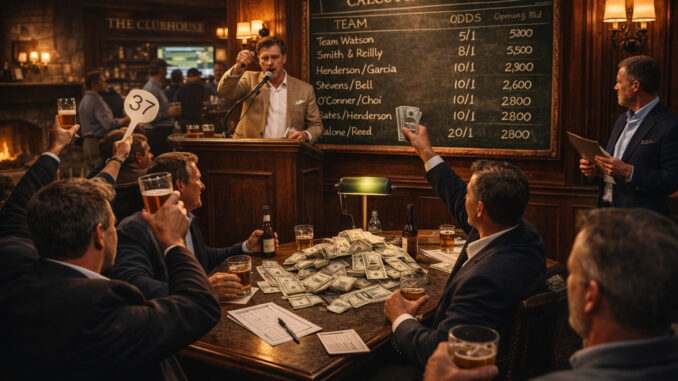
While the history books record the strokes played on the grass, the true heartbeat of the seasonal invitationals is often found within the wood-paneled confines of The Clubhouse the night before the opening tee shot. We are speaking, of course, of the Calcutta—the high-stakes auction that transforms a standard tournament into a high-drama theater of strategic wagering and social intuition.
The Calcutta auction is an institution that demands as much nerve as a four-foot putt for the win. It is the practice of “buying” teams or individuals in an open auction, creating a massive prize pool that often eclipses the formal tournament purse. It is where the club’s resident handicappers test their knowledge against the bravado of the heavy hitters.
The Psychological Auction
Participating in a Calcutta requires a keen understanding of “clubhouse optics.” A player who bids aggressively on themselves is signaling supreme confidence, effectively placing a bounty on their own head. Conversely, the “sleeper” bid—identifying a mid-handicap pairing that has been quietly grinding on the range for weeks—is the mark of the true Clubhouse veteran.
This tradition serves a vital social function. It binds the membership together in a shared financial and emotional stake, ensuring that every grouping on the course has a “gallery” of investors tracking their progress from the veranda.
A Matter of Honor
Because the Calcutta exists in a gray area of formal golf regulation, it is entirely governed by the code of the gentleman. Debts are expected to be settled with the same immediacy as a round of drinks, and the transparency of the pool is paramount. At Fianna Hills, we view these evenings as an essential part of our heritage—a celebration of the competitive spirit that defines our community.
The 19th Hole Epilogue
As the final groups roll into the eighteenth, the tension in The Clubhouse is palpable. The Calcutta winners are toasted, the “busts” are lamented with good-natured ribbing, and the stories of the auction become as legendary as the shots that won the day. It is a cycle of tradition that ensures the game is never just about the score, but about the stories we tell together.