
To the casual observer, a championship putting surface is merely a marvel of aesthetic precision. However, within the professional circles of The Estate, we recognize the green as a complex, living biological system. Among the various cultivars used in modern course design, Creeping Bentgrass remains the gold standard for its ability to provide a true, high-velocity roll. Yet, it is also one of the most temperamental, requiring a master-level understanding of moisture management.
The primary challenge with Bentgrass is not just the presence of water, but the management of its transit through the soil profile. Too little, and the grass enters a state of localized dry spot (LDS), leading to wilt and surface failure. Too much, and the root system suffocates, inviting anaerobic conditions and fungal pathogens that can destroy a green in a matter of hours.
The Physics of Drainage
Modern greens are typically constructed using the USGA method—a layered system of sand and gravel designed to facilitate rapid drainage while maintaining just enough moisture in the root zone through capillary action. When this system is compromised by organic matter buildup or “thatch,” the surface becomes spongy. A spongy green is a slow green, and worse, it is a vulnerable one.
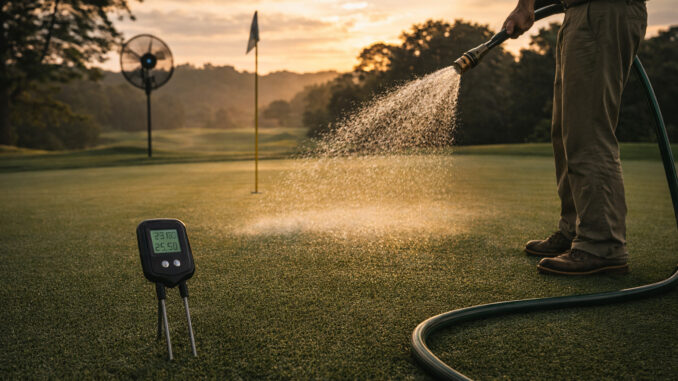
Our recent observations at Fianna Hills suggest that the most successful superintendents are moving away from traditional irrigation schedules in favor of sensor-driven “hand-watering.” By utilizing TDR (Time Domain Reflectometry) probes, staff can identify specific micro-climates on a single green, applying water only where it is surgically required rather than soaking the entire surface.
Evapotranspiration and Air Movement
Moisture management isn’t strictly an underground endeavor. On the ridges of the Ozarks, air movement is our greatest ally. Without proper circulation, a humidity pocket can form over the green, halting the plant’s natural cooling process (evapotranspiration). This is why you will often see strategically placed fans around greens—they aren’t there for the players; they are the life support system for the Bentgrass during the peak of summer.
(Editor’s Note: For those interested in the broader environmental impacts of turf management and sustainable water usage in the United States, the EPA WaterSense program provides comprehensive data on conservation standards).
The Estate’s Commitment
Maintaining the integrity of our greens requires a relentless commitment to data. By balancing the invisible chemistry of the soil with the visible health of the blade, we ensure that every putt rolls with the same predictable purity, regardless of the season. In the end, a great green is built on what you don’t see as much as what you do.