
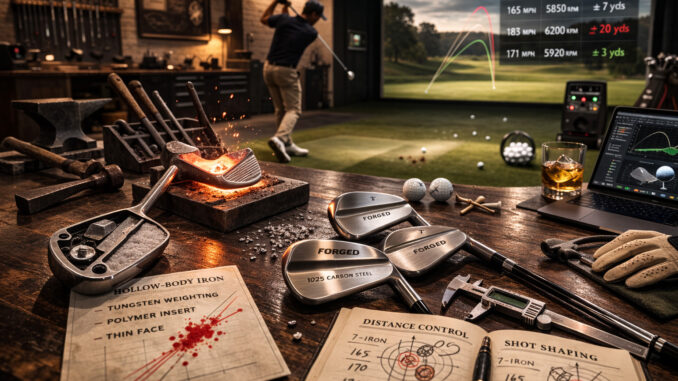
For the past decade, the equipment industry has been locked in an arms race to maximize distance. The result has been the proliferation of the hollow-body iron—clubs packed with proprietary polymers, tungsten weighting, and ultra-thin faces designed to trampoline the ball to unprecedented yardages. For the high-handicapper, these engineering marvels are a revelation. But for the discerning ball-striker, the obsession with distance has come at a severe cost: the death of feel.
Within The Tech Lab, our recent telemetry testing suggests a quiet but definitive shift among elite amateurs and touring professionals. The forged iron is experiencing a renaissance, proving that when precision is the goal, pure steel still reigns supreme.
The Hollow-Body Illusion
The fundamental flaw of the modern distance iron is the “flyer.” When you construct a clubface designed to flex at impact, you introduce an element of unpredictability. Our launch monitor data consistently shows that while a hollow-body 7-iron might carry ten yards further on average, its distance dispersion is erratic. A perfectly struck ball might carry 170 yards, while one struck slightly high on the face might inexplicably fly 185 yards, airmailing the green entirely.
In competitive play, predictability is infinitely more valuable than raw power. You do not need a 7-iron that goes as far as a 5-iron; you need a 7-iron that goes exactly your 7-iron distance, every single time.
The Feedback Loop
A single piece of carbon steel, heated and hammered into shape, offers something a hollow, foam-filled cavity cannot: acoustic and tactile honesty. When you strike a true forged blade or a milled cavity back, the feedback travels instantaneously up the shaft and into the hands. You know exactly where the ball met the face before your eyes even track the flight.
This feedback loop is crucial for improvement. Hollow-body irons mask poor strikes with perimeter weighting and dampening materials, rewarding mediocre swings with decent results. Forged irons demand accountability, forcing the player to refine their mechanics.
The Tech Lab Verdict
At Fianna Hills, we respect the engineering behind modern distance clubs, but we advocate for the precision of the forging process. As our testing confirms, the scorecard does not care how far your irons go; it only cares how close they land to the pin. If you are serious about mastering your trajectories and controlling your yardages, it is time to return to the purity of forged steel.